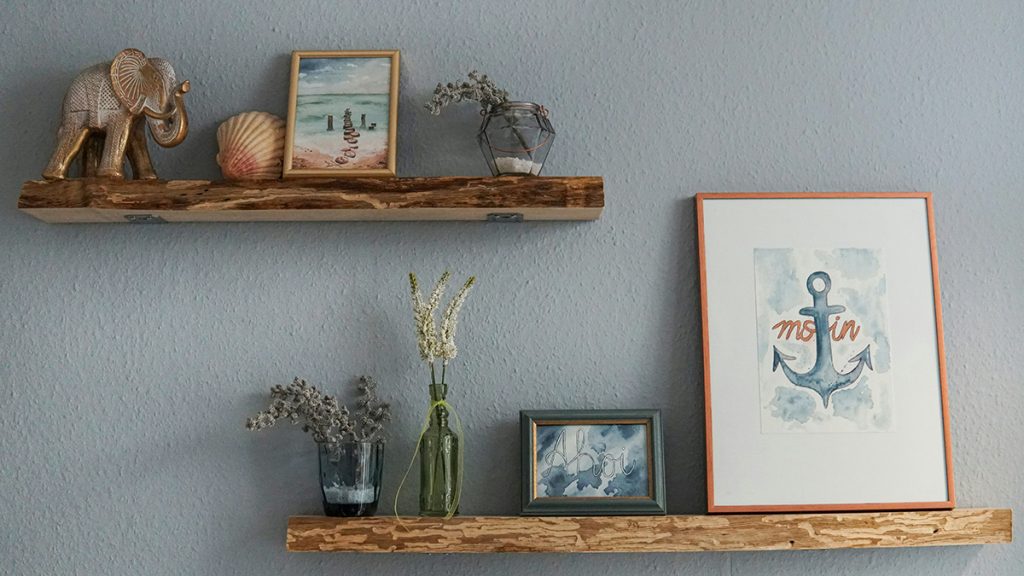
The “floating” effect is an optical illusion powered by engineering. For a truly modern aesthetic, the hardware must disappear entirely inside the shelf. However, not all brackets are created equal. Some sag under the weight of a few books, while others can hold a heavy live-edge slab with ease.
The industry has moved toward interlocking systems and micro-adjustable rods that allow you to level the shelf after it’s mounted. Here is the best hardware available on Amazon to achieve that high-end, custom-built look.
Floating Shelf Hardware Comparison
| Hardware Type | Max Load (per pair) | Best Material | Pro Level |
| Interlocking (Hovr Style) | 300+ lbs | Heavy Hardwood / Slabs | Professional |
| Heavy-Duty Rods (Aksel) | 100 – 150 lbs | 2″ Thick Solid Wood | Advanced DIY |
| Blind Shelf Supports | 50 – 80 lbs | Lightweight / Pine | Beginner |
| Back-Mount Plates | 100 lbs | Plywood / Hollow Core | Versatile |
1. The Ultra-Strength Choice: Hovr Aluminum System
If you are installing a shelf that needs to hold a television or a full bar of liquor bottles, the Hovr Bracket System is the 2026 industry leader.
Why it’s perfect for the modern look:
Unlike rods that can flex, this is a long, continuous interlocking aluminum track. One piece mounts to the wall (hitting every stud), and the other is recessed into the back of the shelf. It creates a “zero-gap” fit against the wall.
-
Pros: Massive weight capacity ($300+$ lbs); prevents sagging entirely; works on wavy walls.
-
Cons: Requires a router to create a deep channel in the back of the shelf.
2. Best for Thick Slabs: Shelfology Aksel HD
For those beautiful 2-inch thick floating mantels, the Aksel HD (Heavy Duty) series is the gold standard for rod-style hardware.
Why it’s essential:
These are individual high-strength steel rods welded to a backplate. The “HD” version is specifically engineered to handle the leverage of deep shelves (up to 14 inches). They feature a slight upward angle ($1^{\circ}$) to compensate for the natural weight of the wood, ensuring the shelf looks perfectly level once loaded.
-
Pros: Extremely rigid; fits perfectly into a $13/16″$ bored hole; various weight classes available.
-
Cons: Requires a drill guide to ensure holes are perfectly straight.
3. Best for DIY Beginners: InnovaShelf EZ LOC
Installing floating shelves is notoriously difficult to get perfectly level. The EZ LOC 1010 series solves this with a patented adjustable system.
Why it’s perfect for woodworkers:
This system uses a double-headed lag bolt. If your holes are slightly off (which happens to the best of us), you can adjust the bracket’s position to bring it to a perfect level. It’s the most “forgiving” hardware for a first-time kitchen remodel.
-
Pros: Tool-free leveling after installation; high-quality steel; great for drywall with studs.
-
Cons: The backplate is slightly thicker, requiring a more precise recess.
4. Best for Slim Profiles: Federal Brace Low Profile
If you want a thin, elegant shelf (less than 1.5 inches thick), most hidden brackets won’t fit. The Federal Brace Low Profile is designed for minimalist aesthetics.
Why it’s essential:
These brackets use a slim, high-grade steel plate that hides behind the shelf. While not “invisible” from the very bottom, they are virtually undetectable from any normal viewing angle. Ideal for bathroom vanity shelves or modern art ledges.
-
Pros: Best for thin lumber; very easy to install; powder-coated for rust resistance.
-
Cons: Visible if the shelf is mounted significantly above eye level.
5. The Budget Value: Star-Work Hidden Brackets
For smaller projects like nursery bookshelves or light decorative ledges, you don’t need industrial-grade steel.
Why it’s perfect for woodworkers:
These are simple “blind” supports available in multi-packs on Amazon. They are effective for shelves made of Pine or Poplar. They offer a clean look for a fraction of the cost of professional systems.
-
Pros: Incredible price; includes all wall anchors; easy to “batch out” many shelves.
-
Cons: Not suitable for heavy loads or shelves deeper than 8 inches.
3 Rules for a “Sag-Free” Shelf
-
Hit the Studs — No Exceptions: Never rely on drywall anchors for a floating shelf, even if the box says “heavy duty.” The leverage of a 10-inch deep shelf will pull an anchor out of the wall like a loose tooth. Always use 3-inch wood screws into the center of the studs.
-
The Drill Press Advantage: To make rod-style brackets work, you must drill a hole into the back of your shelf that is perfectly perpendicular. If the hole is off by even $2^{\circ}$, the shelf won’t slide on or will sit crooked. Use a portable drill guide if you don’t have a drill press.
-
Account for “Wall Wave”: Most walls aren’t flat. If you tighten a long bracket to a curved wall, the bracket will bend, and the rods won’t line up with your holes. Use plastic shims behind the bracket to keep it perfectly straight.
Final Verdict
-
For heavy-duty kitchens and bar areas, the Hovr System is unbeatable.
-
For solid hardwood slabs and mantels, use Shelfology Aksel HD.
-
For easier installation and adjustability, go with InnovaShelf EZ LOC.
Read too: Best Woodworking Projects to Make and Sell for Profit
Disclaimer: As an Amazon Associate, I earn from qualifying purchases. Conquer the elements!