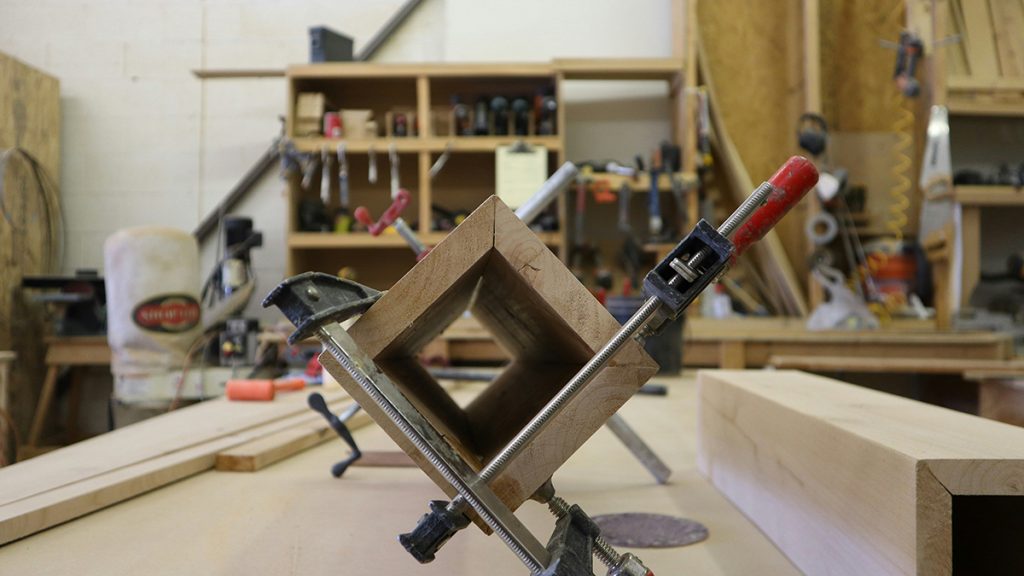
Squareness is the foundation of furniture making. If your boxes aren’t perfectly square, your drawer slides will bind, and your doors won’t close. While traditional bar clamps are great for pressure, Corner Clamps (also known as 90-degree clamps) are designed for alignment and precision.
Whether you are batching out jewelry boxes or building large kitchen carcasses from plywood, having the right clamping jig makes the glue-up process stress-free. Here are the top 5 corner clamps for 2026.
Corner Clamp Comparison Table
| Model | Max Opening | Material | Best For |
| Bessey WS-3+2K | 2-1/2 Inches | Die-Cast / Plastic | Fine Detail / Miters |
| Milescraft 90° CornerClamp | Auto-Adjusting | Steel / Nylon | Pocket Holes / Speed |
| Woodpeckers Clamping Sq. | N/A (External) | Aluminum | Large Cabinets / Pros |
| Kreg 90° Corner Clamp | 1-1/4 Inches | Steel | Drawer Assembly |
| WEN CL19 2-Pack | 2-3/4 Inches | Aluminum | Budget Workshop |
1. The Precision Master: Bessey WS-3+2K
Bessey is the most trusted name in clamping, and the WS-3 is a specialized tool designed to hold two boards of different thicknesses at a perfect $90^{\circ}$.
Why it’s perfect for woodworkers:
The “swivel” head automatically adjusts to the thickness of your material. It’s the gold standard for miter joints. Because it leaves the corner open, you can easily drive a finish nail or screw while the joint is under pressure.
-
Pros: Handles different thicknesses; clear access to the joint; ergonomic handle.
-
Cons: More expensive; limited to smaller stock (up to 2.5″).
2. Best for Speed: Milescraft 90° CornerClamp
If you use pocket-hole joinery for your face frames or boxes, the Milescraft is the fastest tool in the shop.
Why it’s essential:
It uses “Auto-Adjust” technology. You don’t have to turn a screw; you just squeeze the handle, and the clamp automatically locks onto the wood with the right amount of pressure. It’s perfect for holding drawer sides in place while you drive the first screw.
-
Pros: Lightning-fast setup; one-handed operation; very affordable.
-
Cons: Not as accurate for delicate miter joints as a screw-drive clamp.
3. The Professional Choice: Woodpeckers Precision Clamping Squares
Unlike other models, these don’t “squeeze” the corner. Instead, they act as an internal reference. You clamp your wood to the square.
Why it’s perfect for woodworkers:
For large cabinet carcasses, you need an external reference. These CNC-machined aluminum squares are guaranteed to be dead-square. When paired with CSP Clamps, they allow you to assemble massive boxes with $100\%$ confidence.
-
Pros: Indestructible; zero deflection; perfect for large projects.
-
Cons: Requires separate clamps to function; high investment.
4. Best for Drawers: Kreg 90° Corner Clamp
Kreg designed this clamp specifically for the person building kitchen cabinets. It features a unique “wedge” that fits into the corner.
Why it’s essential:
The clamp features a pin that can sit inside a pocket hole or simply press against the side of the board. It pulls the two pieces together while keeping the faces flush—preventing that annoying “stepping” where one board is slightly higher than the other.
-
Pros: Ensures flush faces; excellent for 90-degree butt joints.
-
Cons: Limited capacity for very thick lumber.
5. The Budget Workhorse: WEN CL19 2-Pack
For the hobbyist who needs four corners clamped at once without spending a fortune, the WEN 2-pack is a solid aluminum entry.
Why it’s perfect for woodworkers:
These are simple, rugged, and made of cast aluminum. They feature a quick-release button that allows you to slide the screw in and out instantly without turning the handle for five minutes. Ideal for picture frames and basic shop storage boxes.
-
Pros: Excellent value (sold as a pair); quick-release mechanism.
-
Cons: The screw threads can be slightly “gritty” compared to Bessey.
3 Rules for Square Glue-Ups
-
Check for “Rack”: Even with corner clamps, a large box can “rack” into a diamond shape. Always measure the diagonals of your box. If the measurements from corner to corner are identical, your box is square.
-
Dry Fit First: Never apply wood glue before you’ve tested your clamps. A “dry fit” ensures your joints close tightly and your clamps are positioned correctly.
-
Watch for Glue Squeeze-Out: Corner clamps sit right where the glue likes to escape. Use a bit of blue painter’s tape on the clamp jaws to prevent the wood from being glued to the tool.
Final Verdict
-
For fine furniture and perfect miters, buy the Bessey WS-3.
-
For fast assembly of cabinets and drawers, the Milescraft is the winner.
-
For large-scale professional work, invest in Woodpeckers Clamping Squares.
Read too: Best F-Clamps and Quick-Grip Clamps for DIYers
Disclaimer: As an Amazon Associate, I earn from qualifying purchases. Conquer the elements!