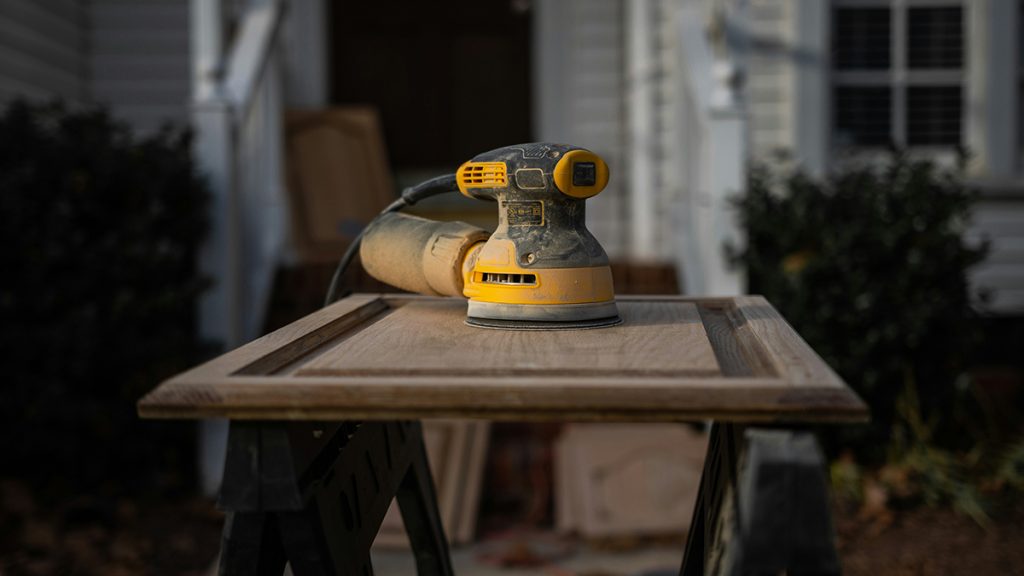

If you ask woodworkers which shop task they dislike the most, the answer is almost always unanimous: sanding. It is tedious, loud, and produces an incredible cloud of ultra-fine, microscopic dust. While a table saw makes heavy chips that drop straight to the floor, an orbital sander creates a powdery dust that stays airborne for hours, settling deep into your lungs, eyes, and every open crevice of your workshop.
Many woodworkers rely on the tiny, fabric dust bags that come strapped to the back of their sanders. However, these bags are highly inefficient. They possess minimal air volume capacity and leak fine dust straight back through the fabric pores, acting like a tiny dust fountain right next to your hand.
To achieve a truly clean workspace, you must hook your sander straight to a high-vacuum shop extractor or shop vac. But bridging the gap between a rigid vacuum hose and a small, proprietary sander exhaust port requires the right vacuum attachments and flexible couplers. Here is a review of the top vacuum attachments engineered to keep your sanding station completely dust-free.
The Anatomy of Sander Extraction: Hose Flexibility and Adapters
When optimizing your sander’s dust collection, standard, rigid 2.5-inch shop vac hoses will not work. They are far too stiff, pulling on your wrist and tilting your sander, which digs the edge into the timber and leaves behind ugly swirl marks. A proper setup requires two critical components:
-
Ultra-Flexible Tapered Hoses: You need a highly pliable, small-diameter hose (typically 1-inch to 1-1/4 inches) that moves effortlessly with your arm, acting like an extension of your own body.
-
Friction-Fit Rubber Adapters: Instead of brittle, hard plastic couplings that rattle loose under vibration, opt for supple rubber or silicone boots that stretch to mold around mismatched port shapes.
The Top Sander Vacuum Attachments Reviewed
1. Rockler Dust Right FlexiPort Power Tool Hose Kit
Widely considered the ultimate small-port collection system on the market due to its highly innovative, stretchable rubber boot tracking.
-
Attachment Style: Expandable hose with 4 interchangeable rubber ports
-
The Highlights: The genius of the Rockler FlexiPort system lies in its rubber composition. Instead of hunting down specific millimeter-sized plastic adaptors for every tool change, the kit provides four distinct rubber boots that easily stretch over odd-shaped, proprietary ports. They hold on via intense friction, meaning they will not slip off even when navigating complex, winding sander profiles. The hose expands from 3 feet to a massive 15 feet during use, then collapses back down into a tight cluster for compact wall storage.
-
Best For: Woodworkers who own a mix of sander brands (DeWalt, Makita, Bosch) and want one single hose that fits all of them perfectly.
2. Cen-Tec Systems Antistatic Power Tool Adapter Hose Kit
A commercial-grade, industrial-strength attachment kit famous for its smooth-interior hose design and 360-degree swivel couplings.
-
Attachment Style: 10-foot antistatic hose with 4 quick-change bayonet fittings
-
The Highlights: Sanding creates massive internal static electricity as millions of fine dust particles rub against the plastic hose walls, resulting in constant, annoying static shocks. Cen-Tec solves this by utilizing antistatic polymers that completely neutralize static build-up. The included rubber adaptors snap onto the hose using a secure click-lock bayonet design, and every single adapter features a built-in 360-degree swivel joint to prevent the line from kinking or twisting during long sanding sessions.
-
Best For: Production shops, high-volume furniture builders, and anybody tired of getting zapped by static electricity while sanding.
3. Bosch VAC024 5-Meter Vacuum Hose
The ultimate premium choice for users looking for an extra-long, ultra-supple hose that integrates seamlessly with European tool networks.
-
Attachment Style: 35mm heavy-duty anti-static hose with integrated nozzle
-
The Highlights: At an impressive 16.4 feet (5 meters) long, this premium hose gives you total mobility across your entire workshop floor without constantly dragging a heavy vacuum canister behind your heels. The integrated rubber nozzle fits directly onto Bosch and Festool sander ports with a factory mechanical click-lock, while friction-fitting perfectly inside standard 1-1/4 inch ports found on other common brands.
-
Best For: Woodworkers managing massive tabletops or large cabinet assemblies who need maximum physical reach and zero static drag.
4. WoodRiver Universal Vacuum Hose Adapter Set
A straightforward, budget-friendly puzzle-style kit designed to solve almost any custom connection problem using trimmable stepped cones.
-
Attachment Style: Stepped rubber adapter sleeve set
-
The Highlights: If you already own a premium flexible hose but cannot get it to link cleanly to your specific sander port, WoodRiver offers the ultimate low-cost fix. The kit provides a series of tiered, stepped rubber cones. You simply slide the cone onto your sander exhaust line until it seats tightly, and then use a utility knife or shop scissors to cleanly trim away any smaller, unused segments to maximize your suction airflow.
-
Best For: Hobbyists on a tight budget who need a quick, highly customizable adapter fix for older sanders.
Sander Attachment Performance Matrix
| Attachment Model | Hose Length | Material Property | Connection Style | Key Shop Advantage |
| Rockler FlexiPort | 3 ft to 15 ft | Expandable Polyurethane | Stretch-Fit Rubber Boots | Boots stretch over highly irregular shapes |
| Cen-Tec | 10 feet | Antistatic Polymer | Quick-Lock Bayonet Swivels | 360° swivels eliminate line kinking |
| Bosch VAC024 | 16.4 feet | Premium Anti-Static Heavy Vinyl | Mechanical Click / Friction | Massive job-site reach; factory tool fits |
| WoodRiver Kit | N/A (Adapters Only) | Rigid Rubber | Trimmable Tiered Sleeves | Low cost; completely customizable sizes |
The Perfect Extraction Sequence: Tuning Your Sander Suction
A common mistake woodworkers make when attaching a powerful shop vacuum to a sander is cranking the suction power to maximum. Too much suction creates a tight vacuum seal beneath the sander’s sanding pad, locking it flat to the wood like a plunger. This chokes the airflow, causes the motor to overheat, and leaves behind deep, circular scratch marks (pigtails). Follow this precise operational sequence to dial in your extraction velocity:
3 Vital Rules for Maintaining Sander Dust Collection Efficiency
-
Clean the Sander Pad Holes Weekly: Over time, sanding sticky resinous timbers (like Pine or Poplar) or processing wet wood glues will cause fine dust to cake and harden inside the tiny suction tracking holes of your sander’s hook-and-loop pad face. Once these holes plug up, your vacuum attachments become useless. Every few projects, peel off your sandpaper, take an air blow gun, and blast compressed air through the holes to clear out any internal blockages.
-
Invest in Clean Sanding Mesh Discs: Traditional paper sanding discs feature a limited number of dust holes (usually 5 to 8 patterns). If your adapter alignment is slightly off, dust collection chokes instantly. To maximize your attachment utility, switch to net or mesh abrasive discs (such as Mirka Autonet or 3M Cubitron Net). These feature thousands of open mesh pores across the entire sheet face, allowing your vacuum attachment to pull air uniformly across the absolute entire footprint of the cut zone.
-
Empty Your Separator Canister Before It Overflows: Fine sanding dust is incredibly light and packs tightly inside vacuum lines. To prevent your vacuum’s expensive pleated cartridge filters from clogging up with cake dust within an hour, always run your sander line through a cyclonic pre-separator (like a Dust Deputy bucket). The cyclone spins the heavy sanding dust out of the airstream, dropping 99% of it into a cheap, easily dumpable bucket before it can reach your main vacuum filter.
Amazon Disclaimer:
As an Amazon Associate, I earn from qualifying purchases. This means that if you click on certain links within this post and make a purchase, I may receive a small commission at no additional cost to you. This helps support the site and allows us to continue creating high-quality DIY content.