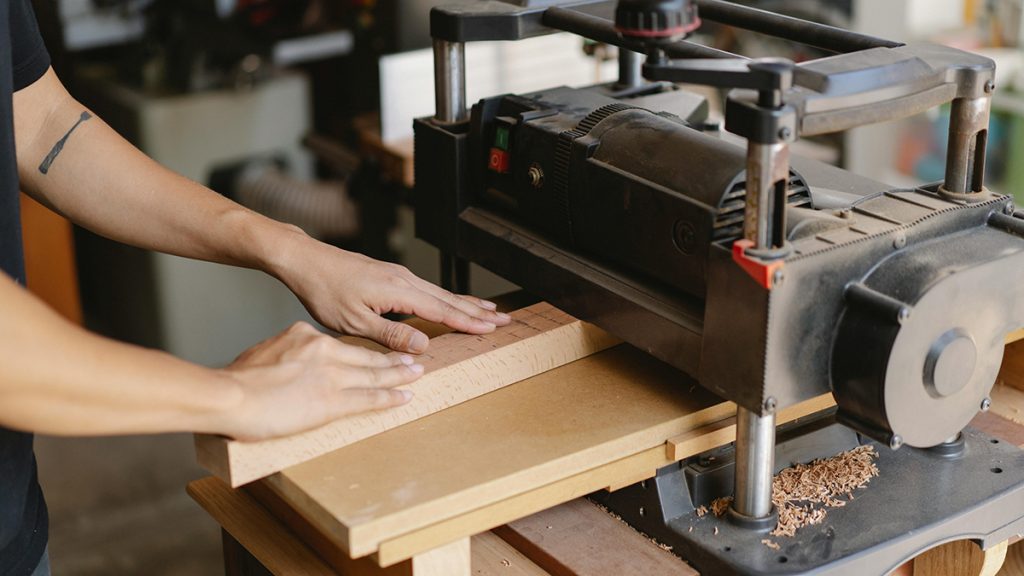
Disclaimer: As an Amazon Associate, I earn from qualifying purchases. Drink clean, hike on!When buying a new planer or jointer—or upgrading your old reliable machine—the biggest question you’ll face is the cutterhead configuration. Do you stick with traditional Straight Knives, or do you invest in a modern Helical (or Spiral) cutterhead?
The cutterhead is the heart of the machine. It determines how much time you’ll spend changing dull blades, how loud your shop will be, and how much sanding you’ll have to do after thicknessing dense hardwoods like Curly Maple or White Oak. Let’s compare the mechanics, cost, and finish quality of both technologies.
Cutterhead Technology Comparison
| Feature | Straight Knife Cutterhead | Helical / Spiral Cutterhead |
| Blade Design | 2 to 4 long, continuous steel knives | Dozens of small, indexable carbide inserts |
| Cut Action | Chopping (slams into wood at $90^{\circ}$) | Shearing (slices wood at an angle) |
| Noise Level | Extremely Loud ($100+\text{ dB}$) | Noticeably Quieter (up to $10\text{–}15\text{ dB}$ drop) |
| Tear-out Risk | High on figured/interlocked grain | Extremely Low |
| Initial Cost | Budget-Friendly | Premium Investment |
| Maintenance | High (sharpening or replacing full knives) | Low (rotate a single insert if nicked) |
1. Straight Knife Cutterheads: The Budget Classic
Traditional planers use two, three, or four long steel knives that span the entire width of the cutterhead.
The Performance Factor:
As the head spins, the knife strikes the wood flat-on. When the knives are brand new and perfectly aligned, they produce a glass-smooth finish on straight-grained softwoods like Pine or Cedar. However, if you hit a hidden knot or a piece of dirty lumber, the entire blade gets nicked, leaving an annoying raised line along every board you plane thereafter.
-
Pros: Lower upfront cost; excellent finish on straight grain; cheaper replacement blades.
-
Cons: High noise levels; setting the knives to the perfect height is tedious; prone to catastrophic grain tear-out on figured wood.
2. Helical Cutterheads: The Shearing Revolution
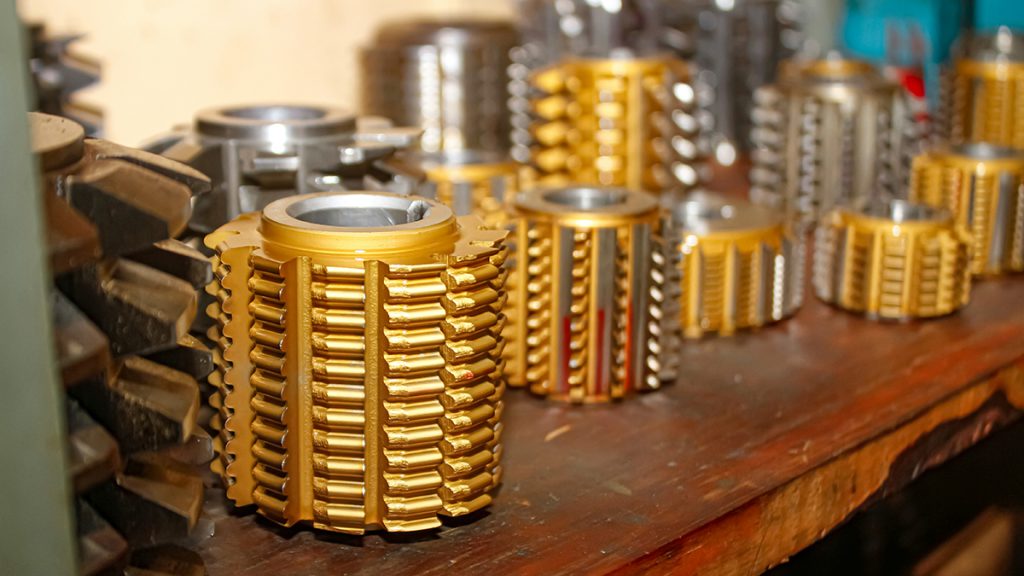
Helical heads feature a row of small, square carbide inserts arranged in a spiral pattern around the shaft.
The Performance Factor:
Instead of a chopping motion, a helical head uses a shearing action. Each insert is slightly angled, slicing through the wood fibers like a knife cutting a steak. This angle completely eliminates tear-out, even on wild grains like bird’s-eye maple or burls. Additionally, the blades are made of solid tungsten carbide, which stays sharp up to $10\times$ longer than standard tool steel.
-
Pros: Virtually zero tear-out; incredibly quiet; indexable teeth (4 sides per insert); carbide lasts longer.
-
Cons: High initial investment; changing all inserts at once takes time.
The Core Battles
Tear-out Prevention
Winner: Helical.
Straight knives lift the wood fibers up as they chop, causing them to split ahead of the cut if the grain changes direction. A helical insert slices down and across. If you regularly work with expensive hardwoods, a helical head will pay for itself by saving boards that would otherwise be ruined by tear-out.
Shop Noise
Winner: Helical.
Straight knives act like giant fan blades, compressing air and creating a deafening “whine” even when idling. A helical head breaks up the air pressure. Woodworkers are often shocked that they can actually hear their dust extractor over the sound of a helical planer.
Maintenance and Downtime
Winner: Helical.
Aligning straight knives with a magnetic gauge can take an hour of frustration. With a helical head, if you hit a staple or a rock, you don’t replace the whole system. You just use a Torx wrench to loosen the affected insert, rotate it $90^{\circ}$ to a fresh edge, and tighten it back down. It takes 2 minutes.
3 Rules for Planer Maintenance
-
Use a Torque Wrench: When rotating helical inserts, always use a small torque wrench set to the manufacturer’s specification (usually around 45-50 in-lbs). Over-tightening can crack the brittle carbide inserts, while under-tightening can cause them to fly out.
-
Clean the Pockets: When you rotate a carbide insert, make sure there is no sawdust trapped underneath it. Even a tiny speck of wood dust will raise the insert slightly, causing a visible line on your planed boards. Clean the seat with a brass wire brush.
-
Wax Your Beds: Whether you have steel or cast iron tables, apply a coat of paste wax regularly. This reduces friction, preventing your planer’s feed rollers from slipping and causing planer snipe on the ends of your lumber.
Final Verdict
-
If you are a hobbyist on a budget who mostly works with straight-grained woods, a quality Straight Knife benchtop planer will serve you well.
-
If you are running a production shop, work with figured hardwoods, or need to keep noise down, a Helical cutterhead planer is the undisputed winner and a mandatory upgrade.
Disclaimer: As an Amazon Associate, I earn from qualifying purchases. Drink clean, hike on!