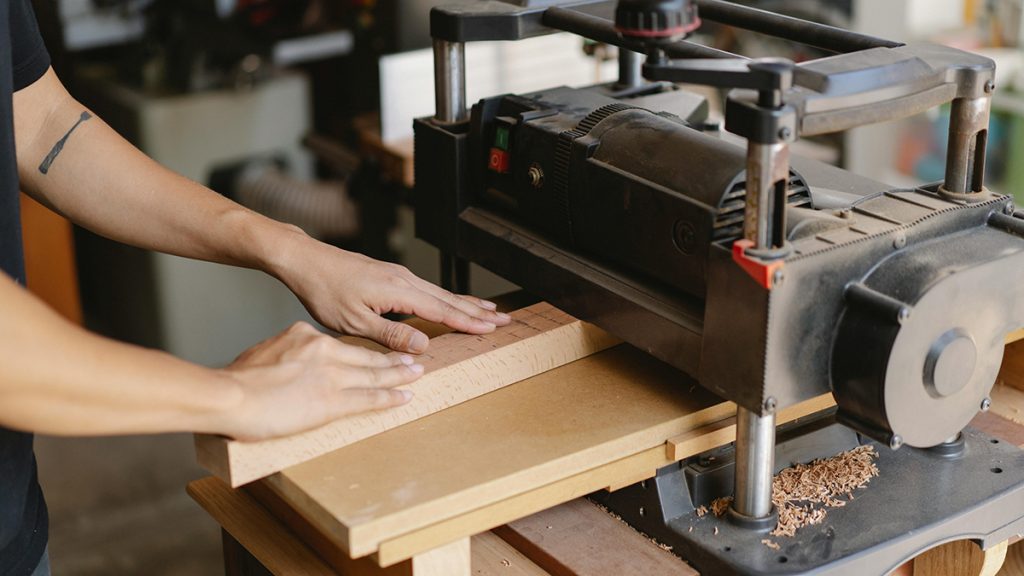

If you’ve ever tried to sand a board flat by hand, you know it’s a soul-crushing task. A Thickness Planer is the solution. It uses a high-speed cutterhead to shave off thin layers of wood, ensuring that both sides of your board are perfectly parallel and exactly the same thickness.
For many woodworkers, a industrial-grade 20-inch planer is too expensive and too large. Fortunately, the “benchtop” planer market has exploded with high-quality options that fit on a mobile tool cart. Here are the top 5 thickness planers under $600 on Amazon that deliver professional results without the industrial price tag.
Benchtop Planer Comparison
| Model | Width Capacity | Motor Power | Key Feature |
| DEWALT DW734 (12.5″) | 12.5-Inch | 15 Amp | Three-Knife Cutterhead |
| WEN PL1326 (13″) | 13-Inch | 15 Amp | Spiral Benchtop Design |
| Makita 2012NB | 12-Inch | 15 Amp | Quietest Operation |
| CRAFTSMAN CMEW320 | 12.5-Inch | 15 Amp | Best Budget Choice |
| RIKON 25-130H | 13-Inch | 15 Amp | Helical Style Cutterhead |
1. The Industry Standard: DEWALT DW734
The DEWALT DW734 has been a favorite for years because of its “Three-Knife” system. Most budget planers use two knives, but the extra knife on the DEWALT provides 33% more cuts per inch.
Why it’s perfect for woodworkers:
It features a massive “four-column carriage lock” that drastically reduces snipe (the annoying gouge at the end of a board). The disposable knives are reversible, so when one side gets dull from pallet wood knots, you just flip them over and keep working.
-
Pros: Exceptionally smooth finish, great dust hood included, very reliable.
-
Cons: Loud (always wear hearing protection); knives are specialized and can be pricey.
2. Best for Hardwoods: WEN PL1326 (13″)
WEN has disrupted the market by offering a “Spiral Style” cutterhead at a price that used to be impossible.
Why it’s essential:
Instead of two long knives, this planer uses 26 small, staggered carbide inserts. This is a game-changer for “figured” woods like Curly Maple or Oak because it shears the wood at an angle, virtually eliminating “tear-out.” If one insert gets nicked by a hidden nail, you only replace that one small square.
-
Pros: Best for preventing tear-out, 13-inch capacity, easy maintenance.
-
Cons: The “spiral” is actually stepped (staggered), not a true continuous helical.
3. The Precision Choice: Makita 2012NB
If you share a wall with neighbors or work in a small garage, the Makita 2012NB is legendary for being the quietest planer in its class.
Why it’s perfect for woodworkers:
Beyond the lower noise level, this planer is built for accuracy. It uses an “Interna-Lok” automated head clamp to eliminate snipe without needing a manual lever. It’s compact and light enough to store on a high shelf when not in use.
-
Pros: Quietest motor, very low snipe, easiest blade changes.
-
Cons: 12-inch capacity is slightly smaller than the competition.
4. Best Budget Choice: CRAFTSMAN CMEW320
For the hobbyist who wants to flatten cedar garden boards or pine projects, the CRAFTSMAN offers solid performance for the lowest price on this list.
Why it’s essential:
It features a standard 15-amp motor and a two-knife cutterhead. While it might require a bit more sanding than the DEWALT, it gets the job done reliably. It’s the perfect “first planer” for anyone starting their woodworking journey.
-
Pros: Most affordable, lightweight, widely available parts.
-
Cons: More prone to snipe; requires careful adjustment of the infeed/outfeed tables.
5. The Advanced Hybrid: RIKON 25-130H
RIKON is a brand that bridges the gap between DIY and Industrial. Their 13-inch benchtop model features a 6-row helical-style cutterhead.
Why it’s perfect for woodworkers:
The 6-row design provides a very clean finish on dense hardwoods. It also features a 2-speed gearbox, allowing you to choose between “Dimensioning” (fast) and “Finishing” (slow). This versatility is rare in a planer under $600.
-
Pros: High-quality finish, 2-speed gearbox, excellent dust collection port.
-
Cons: Can be difficult to find in stock due to high demand.
3 Tips to Eliminate Planer Snipe
-
Lift the Tail: As the board exits the planer, gently lift the trailing end of the wood. This keeps the front of the board flat against the internal rollers and prevents the cutterhead from gouging the last 3 inches.
-
The “Sacrificial” Method: Run a long scrap piece of wood through the planer immediately before and immediately after your project board. The snipe will happen on the scrap wood, leaving your project perfect.
-
Adjust the Wings: Use a straight edge to ensure your infeed and outfeed tables are slightly “upturned” at the very ends. This helps support the board as it enters and leaves the machine.
Final Verdict
-
For the best overall surface finish, go with the DEWALT DW734.
-
For working with difficult grain and hardwoods, the WEN PL1326 is the winner.
-
For the best budget entry into milling, the CRAFTSMAN CMEW320 is your best bet.
Read too: Benchtop Planer Review: Top 5 Models for Dimensioning Lumber.
Disclaimer: As an Amazon Associate, I earn from qualifying purchases. Conquer the elements!