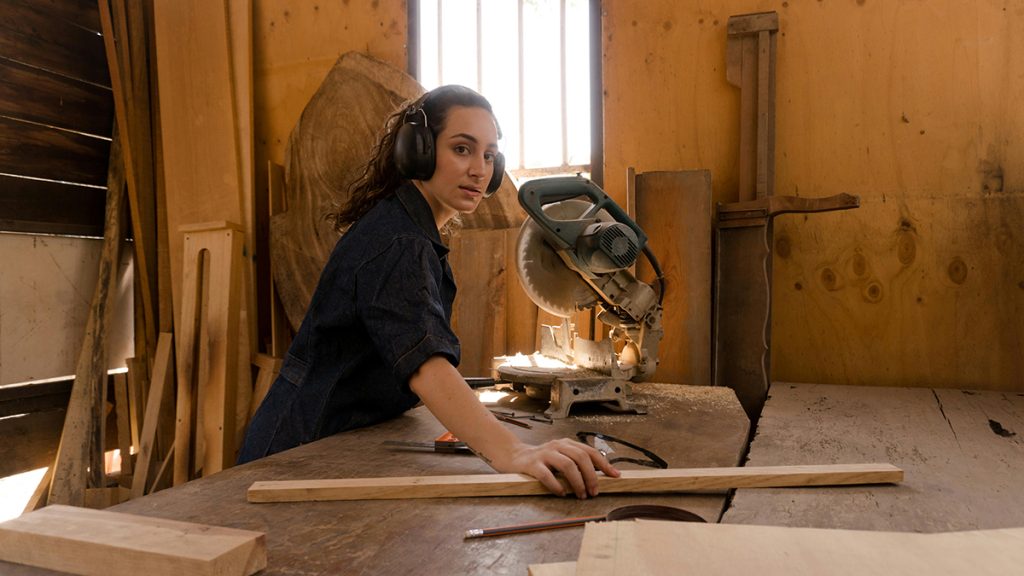
If the table saw is the heart of the shop, the Sliding Compound Miter Saw is the backbone. While a standard miter saw can only chop through narrow boards, a sliding model allows the blade to travel forward and back, giving you the capacity to crosscut boards up to 12 or 14 inches wide with surgical precision.
Whether you are framing a deck, installing intricate baseboards, or squaring up rough-sawn lumber for a tabletop, a high-quality miter saw is non-negotiable.
Here are the top 5 sliding miter saws on Amazon that deliver perfectly square cuts and smooth bevels every single time.
Quick Comparison Table
| Model | Best For | Blade Size | Rail Design |
| Bosch GCM12SD | Overall Best / Space | 12-Inch | Axial-Glide (No Rails) |
| DEWALT DWS780 | Jobsite Standard | 12-Inch | Traditional Sliding |
| Makita LS1019L | Accuracy & Dust | 10-Inch | Forward-Facing Rails |
| WEN MM1214 | Best Budget Choice | 12-Inch | Traditional Sliding |
| Metabo HPT C10FCGS | Ultra-Portable | 10-Inch | Compact Compound |
1. Overall Best: Bosch GCM12SD “Axial-Glide”
The Bosch GCM12SD is widely considered the ultimate miter saw for small shops. Instead of traditional sliding rails that stick out the back, it uses a revolutionary “Axial-Glide” folding arm.
Why it’s perfect for woodworkers: Because there are no rails protruding behind the machine, you can push this saw right up against your shop wall, saving you about 12 inches of workbench space. The glide action is buttery smooth and stays in perfect alignment much longer than traditional sliding systems.
-
Pros: Incredible space-saver, smooth-as-glass movement, massive cutting capacity.
-
Cons: It is a very heavy saw (65 lbs); not ideal if you move it daily.
2. The Industry Standard: DEWALT DWS780 12-Inch
You will see the DEWALT DWS780 on almost every professional construction site in America. It is the definition of a “workhorse.“
Why it’s perfect for woodworkers: It features the CUTLINE™ Blade Positioning System, which uses a high-intensity LED to cast a shadow of the blade onto the wood. Unlike lasers that can get knocked out of alignment, the shadow is always 100% accurate, showing you exactly where the teeth will strike.
-
Pros: Extremely durable, easy to calibrate, best-in-class lighting system.
-
Cons: Requires significant clearance behind the saw for the sliding rails.
3. Best for Fine Trim: Makita LS1019L 10-Inch
While many pros go for 12-inch saws, many fine furniture makers prefer a 10-inch saw because the smaller blades have less “deflection” (wobble) during a cut.
Why it’s perfect for woodworkers: The LS1019L features a unique forward-facing rail system, which—like the Bosch—allows it to sit flush against a wall. Makita is also famous for having the best stock dust collection in the industry, which is vital if you are working in a closed garage shop.
-
Pros: Exceptional accuracy, compact rail design, superior dust management.
-
Cons: Slightly less vertical cutting capacity than 12-inch models.
4. Best Budget Choice: WEN MM1014 12-Inch Dual Bevel
If you are a hobbyist who needs the capacity of a 12-inch slider but doesn’t want to spend $600, WEN provides an incredible value proposition.
Why it’s perfect for woodworkers: It offers high-end features like a Dual Bevel (meaning the head tilts both left and right), which saves you from having to flip your wood over for complex cuts. It’s the perfect entry-level tool for someone building their first profitable woodworking projects.
-
Pros: Very affordable, dual-bevel capability, includes a laser guide.
-
Cons: The fence may require more frequent checking for squareness.
5. Best Portable Option: Metabo HPT C10FCGS
Formerly known as Hitachi, Metabo HPT makes some of the most reliable miter saws for users who need to move their tools frequently.
Why it’s perfect for woodworkers: At only 24 lbs, this is the lightest saw on the list. While it is a “compound” saw and not a “slider” (meaning it has less horizontal capacity), it is perfect for 90% of household trim work and furniture legs. It’s an excellent secondary saw for small tasks.
-
Pros: Extremely lightweight, budget-friendly, reliable motor.
-
Cons: Limited crosscut width (not a slider).
3 Tips for Perfect Miter Cuts
-
Upgrade the Blade: Most saws come with a “construction” blade (32–40 teeth). For clean, splinter-free furniture cuts, replace it immediately with an 80-tooth Carbide Finish Blade.
-
Build a Miter Station: To get the best results, your boards must be supported. Build or buy a Miter Saw Stand with extendable arms.
-
The “Slow Release” Rule: After making your cut, hold the saw down and let the blade stop spinning completely before raising the head. This prevents the spinning teeth from catching and “chipping” the wood on the way back up.
Final Verdict
-
For limited shop space, the Bosch Axial-Glide is the undisputed winner.
-
For rugged durability on a jobsite, get the DEWALT DWS780.
-
For maximum precision and dust control, go with the Makita LS1019L.
Disclaimer: As an Amazon Associate, I earn from qualifying purchases. Conquer the elements!
Read too: Top 5 Cordless Circular Saws for Mobility in the Shop